How the Religious Society of Friends began
The Protestant Reformation of the 16th century challenged centuries of all Christianity coming under the wing of a single, centrally controlled Catholic Church.
Henry VIII of England had been called “Defender of the Faith” for his opposition to Martin Luther’s reforms — but then established himself as head of the Church of England when the Pope refused an annulment of his marriage with Katherine of Aragon. Further, English religious policy varied depending on who was King or Queen of England. This came to a head with Charles I (1625–1649) on the throne. Charles had Catholic leanings, and a Catholic wife. His quarrels with Parliament led to the English Civil War (1642–1651), in which the Parliamentarians (“Roundheads”) fought against the Royalists (“Cavaliers”). The Parliamentarians were ultimately victorious, and Charles I was executed.
This was the period of upheaval and foment in which Quakerism and many other “non-conformist” faiths were born! Dozens of “non-conformist” religious groups that were unwilling to recognize the authority of the Church of England arose starting in the middle 1600s, including the “Quakers”.
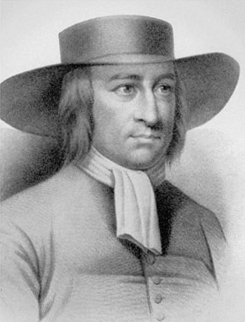
George Fox (1624–1691) was born in Fenny Drayton, Leicestershire, England, the son of a weaver. As a young man, Fox became increasingly disillusioned with the religious life of his time. He left Fenny Drayton in 1643, at the age of 19, in search of spiritual nourishment; he found little help from any church.
On his travels, Fox would have also encountered many other “seekers” who, like him, felt the churches had become bogged down with traditions, rituals and power politics, and seemed to be giving contradictory messages.
At age 23, at a time when he felt himself in the depths of despair, he heard, as if spoken by a voice, the words “There is one, even Christ Jesus, that can speak to thy condition”. He later wrote “When I heard it my heart did leap for joy”. Thus, Fox’s message was born: everyone can make direct connection with God, without the intervention of a priest, minister or pastor. This led to a desire to bring about a sort of renewal of Christianity through a return to early, pre-Church Christianity, and to find a way to live out Jesus’ message more simply.
In due course Fox’s followers called themselves The Religious Society of Friends. Many, including Fox, suffered persecution and imprisonment for their beliefs. “Quaker” was a nick name which stuck, and now we are known as Friends or Quakers.
Fox and other members of the new “Society of Friends” moved throughout England, Europe and America, preaching their message powerfully – the intrinsic Equality of all, the ability of each to make direct contact with the Divine (Jesus Christ), the need to live simply, the unacceptability of using violence of any sort. Friends were to be simple, plain, honest, unostentatious, industrious, courageous. In their vision of the world they wished to create, the poor would be cared for. There would be no tale-bearing or detraction. There would be no swearing of oaths, since Friends declared they lived with integrity and would therefore always be truthful .
Early Quakers hoped that Quakerism would become the dominant religion throughout England, and even the world. When George Fox died in 1691, the Society of Friends numbered tens of thousands, and totalled about 1% of England’s population. Although this fell far short of the early Quakers’ dream, this is still an incredibly rapid expansion in a time without television, radio or motorised transportation.
The Society of Friends had also expanded in the early 1680’s across the Atlantic Ocean to the East coast of “British America” with William Penn, who established Quaker governance in his territory of Pennsylvania. Pennsylvania became a haven for religious and political tolerance, run according to Quaker principles, and had no army for many decades.
An interview with several English historians about the origins and early history of the Quakers can be heard at the link
https://www.bbc.co.uk/programmes/b01f67y4
 quakers-in-ireland.ie
You must be logged in to post a comment.