REPORT ON IRELAND YEARLY MEETING 2015
For the second time in three years Ireland Yearly Meeting [IYM] was held in a new venue. This year we met in Dromantine Conference and Retreat Centre, Newry, Co Down, in Northern Ireland. Set above a lake, surrounded by rolling grassy areas and woodlands, the building was a comfortable and compact centre. Many Friends enjoyed walking in the peaceful grounds, enjoying the summer-like weather which was with us for most of our stay. We welcomed Friends from Britain, German and France Yearly Meetings as well as eleven Friends from America. We were pleased to be joined also, by representatives from other churches, and the Baha’i Faith.
The theme for the weekend was ‘ Knowing God’s Creation – I have taught you wisdom and the right way to live. Nothing will stand in your way if you walk wisely and you will not stumble when you run.’ Proverbs 4:11-12. This was the inspiration for the daily readings, many of which were poems. Bible Study, Worship Sharing and Epilogue gave opportunities for exchange of thoughts and wisdom.
In the Ministry and Oversight Session on Truth, we heard the story of the wise man and Saint Peter. When the casket of Truth was dropped by the wise man at the gates of heaven, people rushed to pick up the pieces, but they didn’t realise that none of them had the whole truth….they only had a part of it. Early Friends were called the Friends of Truth, and the testimonies of honesty and integrity remain important to us. In journalistic circles, truth can be slippery! Do we really treat all people equally, even those we find difficult? Do we live as though God has the power to lead us? Can we accept our part if difficulties arise? Jury service is a time of seeking for the truth, and through prayer, searching for guidance to make the right decision. ‘The truth will set you free.’ John 8:14. The Bible was the source of truth for early Friends, but not the truth in itself. Love comes before truth. If all the world’s religions were placed in a circle, some would be opposite each other. With God in the centre, as the religions move closer to God, they move closer to each other.
Eco Congregation Ireland is now ten years old. The Christian calling is to nurture and care for creation. Coming from different churches to work together for the care of God’s creation, is natural ecumenism. The vision of the Foinse Project [meaning ‘source’], is to establish a field study and scientific research centre in Leitrim/Fermanagh/Cavan counties. By using tourism and accommodation centres out of season, they envisage a light footprint. There is pride in the local community that others want to study their area. It will involve three administrative authorities working together; from the North and South of Ireland and also America. Yearly Meeting agreed to support this project. A film made by young people in Fermanagh, showed what the consequences would be if fracking was allowed in their area. If the pastoral environment and current means of livelihood are to be conserved, this also requires co-operation between authorities North and South.
Irish Quaker Faith in Action [IQFA] is both a fund-distributing, and a service, committee. They are glad to hear of activities, both at home, or abroad, suitable for their support. Christian Aid is one of these. Established seventy years ago, they work to change an unjust world. Our actions fail to show a belief we realize we are equal. Three Planet Earths would be needed to sustain a world as consuming of fossil fuels as Ireland is. We must share the fruits of the earth. Every family has the right to be at the table. While we must give, act and pray, there is no point in giving a fisherman a net when there are no fish in the water, because of pollution from a foreign enterprise up stream, which is not paying proper wages or taxes. We heard of Christian Aid’s work in Kenya and saw a film of work in Brazil. People are asked what their requirements are, and then empowered to develop self-help community projects.
In 1693 William Penn wrote of a united Europe, but where states would maintain sovereignty over their own affairs. Quaker Council for European Affairs [QCEA] is thirty six years in existence. Though modern means of communication are used, our current representative gets up at two a.m. to reach Brussels in time for the three p.m. meetings; because of the value in making contacts, as well as the business carried out. The opportunity is there for Irish Friends to have much more input into QCEA, and its influence in European Union [EU] policies. Concern was expressed about the outcome of the pending trade agreement between Europe and America.
One of our ecumenical visitors said they were looking forward to the outcome of our discussions on Neutrality at YM…..We agreed to support Western Regional Monthly Meeting in their concern about the use of Shannon Airport by United States military aircraft. Limerick Friends try to have a representative present at the monthly Peace Vigils held at Shannon.
A film was shown called ‘Waiting and Silence’. Made by a member of Coleraine Meeting, it is aimed at ‘the curious’. Outreach was the subject for one of the Interest Groups and was led by two brothers. One said,’ IYM copes by being nice to each other. Do we have a united message?’ Christ’s message was ‘to go into the corners of the world transforming’. The other brother told us of many ways to get our message across. Some Meetings have a website, one has a Facebook page, but technology has its limitations.
Further discussion on Membership took place, following the setting up of the Purposes and Priorities Working Group [PPWG] to enquire into the spiritual life of our Religious Society. The outcome of considerations at Preparative Meeting level appeared to be that there was a need for commitment. While the ‘weighty Friend’ has a value, new Members should value their upbringing outside the Society.
The Public Lecture, given by Alastair McIntosh – which is to be available in due course on DVD – was a challenge to many, in many ways. ’To be the People of the Cross- Climate Change, Violence and some Meanings of Creation in Our Times’. Climate Change is one of the major concerns, is happening, is very serious, and is brought about by human actions. Too much greed, not too many people. Sustainable living allows for future generations to live. ‘I have given them fountains of living water, but they build cracked cisterns that hold no water at all’ Jeremiah 2:13. Alastair referred to his Scottish Presbyterian upbringing on the Isle of Lewis, and to the abundance of spiritual mystical experiences. He led us through events leading to the death of Jesus on the Cross; how different people acted- Mary Magdalene, Peter, Simon of Cyrene, and Joseph of Arimathea- and the consequences of their actions. Jesus never taught a ‘just war’. God would rather die than kill. So Jesus accepted the Cross.
‘Living the Transformation – Creation waits with eager longing for the revealing of God’s children.’ [Romans 8:19] will be the theme of the FWCC Gathering next January in Peru. As well as the 300 places for International Representatives, there will be 100 Open Places for any interested Friends, and 250 places for Friends from Peru and Bolivia to attend the open weekend. A lively video made by Peruvian Friends was shown. T shirts were for sale and donations were being sought to enable local Young Friends attend the Gathering.
We heard how meticulous Quaker minutes and certificates, census returns, tithe and tax records, had enabled the tracing of the Starr Quaker family, who left from near Dromantine in the 17th/18th century to settle in America. We were educated and entertained by a preview of a play based on the life of a Conscientious Objector during the First World War.
Our YM Youth Coordinator reported five years of lots of fun, while doing valuable work in building relationships, fellowship and leadership skills with our Young Friends. Some YFs are participating in discussions on ‘Preparing for Ministry in Meeting.’ Personal Bible study of early Friends helped to equip them to speak in Meeting. Early Friends read the books in Quaker libraries rather than just looking at them! As we rest in God’s spirit, so His spirit rests in us. JYM attendances are rising and reports of their weekend were enthusiastic. They were encouraged to find nonviolent responses to challenging situations and in campaigns they might support. Revision of IYM Child Protection Guidelines is nearly complete and will now include a section on social media. It is hoped the Guidelines will be launched this June and they could become available on Kindle.
On Sunday we moved to Bessbrook Meeting for our closing session and Meeting for Worship. A short video gave us the history of the 19th century building and featured some of the current Members. The Recording Clerk was not to be seen as we settled for the session. A local Friend, she had driven a shorter way to Bessbrook, and on her way had spotted a ewe on its back in a field. Our Friend climbed over the field gate, twice pulled the sheep to its feet, but as the animal was too weak to stand or feed its lamb, she contacted the land owner; on her arrival, she then resumed her Recording Clerk duties! Another friend had driven through snow coming from his home, to Meeting!
One Friend was taken aback on seeing all the cars outside Dromantine and was dismayed with our carbon footprint. Another said they were uncomfortable, after reminding us of the struggle for others, to find enough food and water, in many parts of the world. He recalled the warm welcome given to him by a family in Kenya, when there for the Gathering in 2012. YM agreed to send a letter of sympathy to Kenyan Friends, who have lost some of their members in the recent terrorist attack.
In conclusion, while we had eaten 10 fruit cakes by Friday evening, the artichokes remained unsold on the IQFA stall! There were wood turned items for sale and lovely knitting and crotchet items too. ‘Quaker Service’ red carrier bags were eye catching and also for sale. The Quaker Books on sale looked colourful and attractive. We agreed we were ‘content’ with the minutes, and I think we were, also, with the Yearly Meeting as a whole. However, ‘I can’t hear what you are saying because of all the words’, said a Friend……… We must let our lives speak.
 IYM Education Committee and Youth Coordinator are hosting worthwhile trainings which will help us support our Young Friends better.
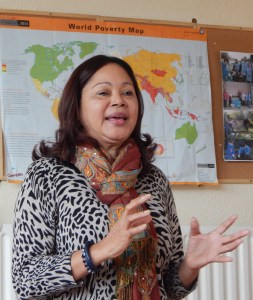 Maria Genao, who undertook a speaking tour of Ireland to mark Fairtrade Fortnight, said that the impact that Fairtrade had on the lives of small producers were many. “It ensures our work as producers by protecting the market throughout the year, by helping us in many ways to keep growing and by being there through tough times when we are in need,” she said.
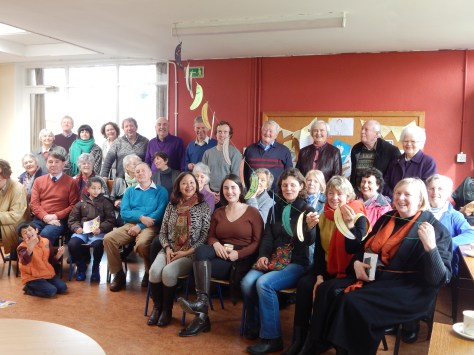 Rathfarnham Friends were pleased to be joined by Friends from other Meetings – adults and children – to hear their special speaker.
 quakers-in-ireland.ie
You must be logged in to post a comment.