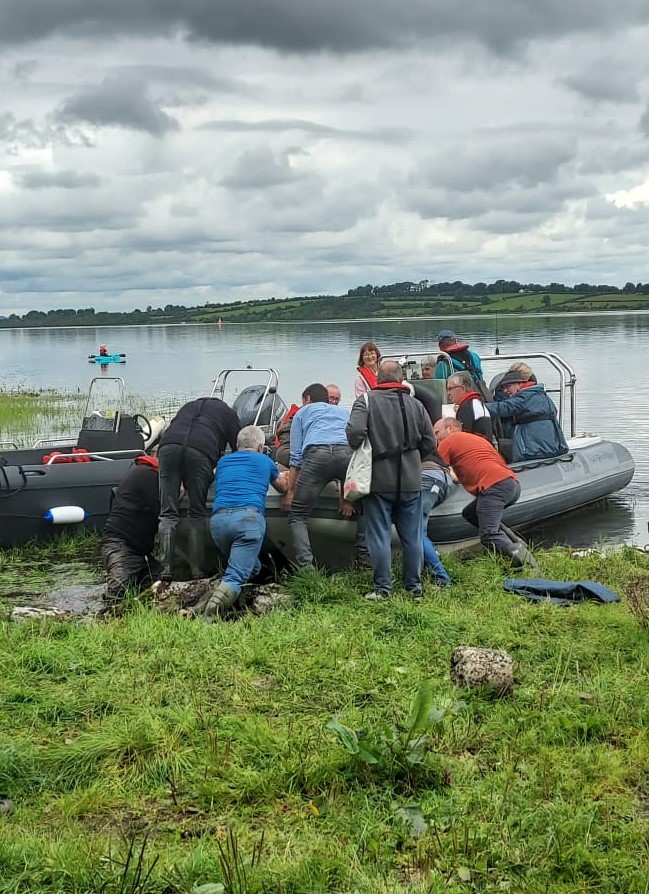
Tim Coughlan represented Friends at a recent visit to Inchcleraun, otherwise known as Quaker Island.
Inchcleraun is most famous for the group of early Christian and medieval churches on the island. A monastery was founded there in c.540AD by St Diarmuid.
Edward Fairbrother (1765 – 1838) originally from Ballymurry Friends in Roscommon, whose homestead is still visible there, is associated in popular memory with the name “Quaker Island”.
This video is a snapshot from what was described as a “magical” day, exploring the Island and learning about its history and heritage.
We gathered for Ireland Yearly Meeting 2023 in the Dominican Retreat Centre, Tallaght, West Dublin. Tallaght was a small village in the 1950s and has grown to be the third largest town in Ireland. St. Maelruan founded a monastery there in 769 and it was a place of pilgrimage for a thousand years. The four pillars of Dominican Life are prayer, study, community, and preaching, neatly capturing our theme for 2023 – Building Community Together – and gently reminding us that there are few ideas or aspirations novel to Christians over the past 20 centuries.
As ever, the joy and miracle of IYM is the meeting of old Friends and the making of new ones. We need only make one new acquaintance or come away with only one resolution, but that is sufficient. More is less. Coming together in person is invaluable beyond any zoom or remote contact. It is why IYM in person continues to be the highlight of our Quaker year.
For those who cannot attend IYM in person, it is wonderful that we can now offer the option of attending remotely. All the plenary sessions this year were blended, with several speakers joining us online, and the quality of sound and video recording was very good.
During the week before IYM began in person, a series of Special Interest Groups were held on Zoom – exploring Quaker history, life reflections, peace-making and food waste. These encouraged thoughts and conversations to which we returned during the in-person meetings.
A notable concern across many of our sessions was how to connect, or reconnect, our communities in the aftermath of the Covid-19 pandemic. We shared experiences from our meetings and heard from representatives of other faiths. We heard that post COVID is an opportunity not a threat, that we need to break out of buildings to “be a light in our communities”. We should concentrate less on “events” and more on service to the community. Interfaith dialogue can be hard work, with a mix of attraction and aversion, like magnets. “Why do Quakers do it?” We do it to find out others’ experience of the Light. If we do not do it, then misunderstandings can grow into difficult barriers.
We also considered our wider Quaker Community. It was heartening to hear from Friends from Brussels, Britain, Norway and Finland. Stuart Masters from Woodbrooke joined us on Zoom and shared information on the Community of Early Friends. Tracey Martin of QCEA in Brussels spoke of the progress they had made after the difficulties that followed Brexit.
At our Yearly Meeting on Ministry and Oversight, a panel of three friends reflected on how we can encourage ministry in our meetings. The question was asked: “is our silence killing Quakerism?” One speaker quoted Thomas Kelly, that we should seek the inner flame, to listen to that of God within and ask oneself “What do you find of God there?”. Another speaker found that she had learned to listen to the still small voice within. To speak only from the heart. To encourage one another to minister, but to be led by the spirit as to whether one might speak or not. A third speaker reflected on George Fox’s experience at Firbank Fell – “Let your life speak”.
In the discussion that followed, some spoke of the deep value of the silence, especially new attenders. There was a suggestion that one might use a verse of scripture. Another spoke of the value of spoken and unspoken ministry; that both are valuable.
Another concern which manifested over several sessions at IYM was peace making and peace building. Reflecting on the Quaker Peace Testimony, we heard how Quakers have responded differently to wars over the past century. While all Quakers are peace makers, not all are pacifists, and we rely as always on the Spirt and our conscience to guide us. It was accepted that the current war in Ukraine does not admit simple analysis but requires prayer and reflection and patience with one another. A practical solution which might be offered is to make refugees of whatever origin feel welcome and to work against a pernicious anti-immigrant culture, still small but vocal in Irish society.
We reflected on how we can prepare for peace, hearing about work to prevent increasing militarism, and campaigning against the arms industry. Florence Foster spoke about the peace building work of QUNO in Geneva. Friends also spoke of their experience hosting refugees from Ukraine. In discussion, we asked how Friends can help to create the conditions for peace in our own communities, with peace education programmes in schools and organising local events suggested.
As always, our Young Friends both inspired and challenged us. Our under-10s had learnt about Ukraine and the experience of the refugees. They displayed their stones painted in yellow and blue and their paintings of sunflowers, which brightened our day. We heard the epistle from JYM which appealed for more support and guidance from IYM. More adult volunteers are needed to enable fun weekend events to be organised.
We were also challenged at a session on nurturing community, which dealt with our role on social media. As well as a form of outreach, social media is a way of building and nurturing community, but Friends are not availing of it. We heard about The Friendly Podcasts, a lockdown project which interviewed Irish and international Friends, now available on our website. A show of hands proved that a significant number of Friends are active on social media in their daily lives, but a second show of hands showed that very few were engaging with Quaker material. We left with a renewed sense of purpose, to follow IYM on Twitter and Facebook, and to like and share the posts regularly!
A highlight for many at IYM this year was the Public Lecture given by Harvey Gillman on “Hospitality and the Pilgrim – a Quaker’s reflection on communion and community”. It was a highly entertaining and engaging lecture, if indeed the word lecture is appropriate. Harvey gently chided us for using ‘quakerspeak’ with people unfamiliar with our culture. One could see why Harvey served for a quarter of a century as outreach coordinator with British Friends in London. He managed to speak to people where they are, not where we might wish them to be. It was Harvey’s experience that it was within the Quaker community he could find his real voice, his real self and his happy home. Many Quakers by convincement can find an echo is this sentiment. The entire lecture is available online on www.quakers.ie
Of course, as well as the plenary sessions we had bible readings, candlelit worship in the oratory, poetry reading, dancing and the much-loved IQFA and book stalls, all facilitated by the many Friends who volunteered. Special mention to all who facilitated the catering and the numerous cups of tea during the day. If an army marches on its stomach, Quakers survive on caffeine. A friend once remarked the most important part of Meeting was the cup of tea afterwards!
Valerie O’Brien, Colm Hefferon, Padraic Murray and Bairbre Nic Aongusa
The title of this year’s lecture was: Hospitality & the Pilgrim: a Quaker’s reflection on communion and community given by Harvey Gillman.
A copy of his pre-talk text is available here via this link.
Or you can watch a recording of Harvey’s talk here >>
Through reflections on his own life journey, Harvey, who is a Member of Britain Yearly Meeting of the Religious Society of Friends, explores spirituality as a process of hospitality.
Harvey (who describes himself as a seeker, finder, explorer, discoverer, dissident, exile, would-be poet and heretic!) sees every human being as a pilgrim.
“We look for meaning, a sense of belonging and a way to act in the world which seem true to our experiences,” he says. “The self, the other, and the world itself are inter-related. How do we forge links in a world that often seems to pull us apart?”
Harvey, who was brought up in the Jewish tradition and joined Quakers as an adult, says he has always desired the constancy of community and that Friends/Quakers offered him the hospitality he was looking for and a space in which to breathe.
To mark International Day of Climate Action 2022 (24th October), EcoQuakers Ireland has released a video of the sustainability gathering it hosted in Cork earlier this year.
The title of the event was ‘From Disappointment to Hope: Actions and Responses to Climate Breakdown’ and the speakers were Brían Ó’Súilleabháin, Convenor of EcoQuakers Ireland, Rev Andew Orr, Chair of Eco-Congregation Ireland, and Caroline Robinson, a Cork-based organic farmer.
Fran Brady of Dublin Meeting, who is the Religious Society of Friends representative on Eco-Congregation Ireland and a member of the EcoQuakers Ireland committee, wrote the following report about the gathering:
On 23rd April 2022 the EcoQuaker Munster Gathering was held in Cork Meeting House, against the backdrop of the Loving Earth Project, an exhibition of textile panels created by Quakers to celebrate the earth and to highlight how the earth is endangered by climate change. Thirty-seven people attended.
The objective of the gathering was to encourage those present to be active on issues of climate justice, loss of biodiversity and other environmental concerns within their Quaker Meetings or churches, as well as in their everyday lives.
The gathering opened with a period of reflection during which attendees could briefly share something about their environmental story.
One nurse spoke of 80,000 trees planted by a Co. Cork nurse to offset the huge environmental footprint of health services.
A Sabbath for the land every seven years and a Jubilee year after 47 years to give the land a rest was lauded.
The many and varied contributions set the tone for an inspiring Gathering, where three excellent speakers spoke on the topic: “From Disappointment to Hope: Actions and Responses to Climate Breakdown”
Brían Ó Súilleabháin, actor and convenor of the Eco Quaker Ireland Committee, charted the work of EcoQuakers since the World Quaker Gathering in Peru called on Quakers to live out the changes needed to sustain the Earth as home to humans and the natural world. Following on this call, Ireland Yearly Meeting 2016 asked Meetings to develop sustainability plans no matter how simple.
A survey of Meetings early in lockdown showed a willingness to be sustainable but a need for a blueprint. This revelation led to the researching, compiling and publishing in 2021 of Regenerating our Common Home: Quaker Considerations for Restoration and Protection of the Environment. This book shows how our everyday activities can contribute to pollution, desertification, bio-diversity loss, extraction of fossil fuel and climate change. A step-by-step guide as to how to make a difference within and outside our Meetings, the book provides definitions and calculations for sustainability, carbon zero, carbon neutral and many other concepts. The final chapter is a case study of the eco-refurbishment of Cork Meeting House, which provided EcoQuakers with a wonderful space for the gathering,
Rev Andrew Orr, Anglican Priest-in-Charge of Youghal Union, Chaplain to Midleton College and Chair of Eco-Congregation Ireland (ECI) spoke about Eco-Congregation Ireland, founded in 2005, to encourage and mentor churches and congregations along their sustainable journeys. ECI’s affiliated congregations are Roman Catholic, Church of Ireland, Presbyterian and Methodist Churches and the Religious Society of Friends (Quakers).
Environmental measures can be incorporated into all aspects of life: Spiritual, Practical, Community and Global. It’s under these headings that congregations are assessed for an Eco Award. A Gold Award has been initiated for congregations who accomplish exceptional environmental work after their initial award and who mentor another congregation.
The gift of God’s creation is celebrated especially at the Season of Creation and Harvest Time while Climate Justice Candles raise awareness of environmental justice in churches and congregations. Andrew spoke about the challenges, and opportunities, of endeavouring to make buildings and land as sustainable as possible. Climate Stewards, a web-based tool, enables churches to measure the carbon footprint of different activities; energy, travel, food, waste, water and other expenditure. The All Ireland Pollinator Plan, an initiative to aid bio-diversity and sustainable land use, is ideal for churchyards and burial grounds.
Organic farmer Caroline Robinson, who has been growing food without chemicals for nearly a quarter of a century, said it is humbling to work with nature and iterated that, if chemicals are avoided, land gets better and better. Her belief is that healthy soil results in healthy vegetables, rather than trying to feed vegetables planted in impoverished soil. There is freedom and independence attached to growing food, especially in the current world situation.
Caroline and her husband produce local food for local people, making their food available at local Farmers’ Markets. In the small group discussions, and the plenary session which followed, food sovereignty, including indigenous food sovereignty, featured strongly. Indigenous crops grown over many years regenerated land rather than depleting it. Indigenous people have much to teach us about food and farming. Though climate scientists often overlook traditional knowledge, conglomerate farmers are devoid of the innate knowledge and wisdom gained over generations, which keep small farming systems in balance. Food conglomerates tend to homogenise food systems, reduce variety of crops and ignore natural harmony.
Andrew finished his talk with a quote from the Ecumenical Patriarch Batholomew of Constantinople: “The real crisis lies not in the environment – which suffers the consequences of our actions – but in the human heart. The fundamental problem is to be found not outside but inside ourselves, not in the ecosystem but in the way we think about, perceive, and treat this ecosystem.“
You can find out more about EcoQuakers Ireland here.
Welcome to The Friendly Podcast – a collection of Quaker voices!
The Friendly Podcast is an Ireland Yearly Meeting production featuring Quakers of all ages and backgrounds, at home and abroad, sharing their experiences and views as 21st century Friends/Quakers.
Do not be conformed to this world, but be transformed by the renewal of your mind. (Romans 12:12)
Margaret Fraser
“We came as visitors, but you made us feel at home.”
“It was wonderful to have so many inspirational speakers. That gives me hope.”
“It’s important to have perspectives from across Europe and the rest of the world.”
“I want to say a big thank you for all the help.”
“It was a wonderful first visit to Ireland; now I carry Ireland Yearly Meeting in my heart.”
At the closing session, participants from other European countries rose to express gratitude for the four-day residential meeting. A member of the host Yearly Meeting added:
“I commend the clerking team and the Programme Committee for planning such a full and rich programme, expediting business to allow space for a truly enriching Yearly Meeting.”
“Hi folks. You here for the wee convention?” When the security guy at the campus gate of Stranmillis University College greeted us on the first morning, I knew that, at the third attempt (the first two years thwarted by Covid) we truly were gathering in Belfast. Like the other major denominations, Quakers have never accommodated to the political border set in place in 1921, and Ireland Yearly Meeting covers the island of Ireland.
During our opening worship Patrick Kavanagh’s poem, The Long Garden was read. It begins:
It was the garden of the golden apples,
A long garden between a railway and a road,
In the sow’s rooting where the hen scratches
We dipped our fingers in the pockets of God…
A letter of greeting from Britain Yearly Meeting was read out, together with a summary of other Yearly Meetings’ epistles. The effects of Covid and expressions of hope had been a theme running through all of them, with invitations to draw nearer to God being a common theme among the African and Latin American yearly meetings.
We heard that attendance at Meetings for Worship throughout Ireland had fallen during the pandemic. Responses to hybrid worship had been mixed, with some meetings not wanting to participate, and others engaging readily. At the Yearly Meeting sessions, we embraced it. In addition to parts of Ireland, Friends zoomed in from Britain, Burundi, the Republic of Georgia, Kenya, Lebanon, Mexico, Russia, and the USA. Between a quarter and a third of those present were on Zoom. It was also good to have the in-person participation of visitors from Belgium, Britain, Germany, the Netherlands, Norway, Portugal, Switzerland and the USA. Visitors also joined us from the Belfast Jewish Community, the Catholic Church, the Church of Ireland and the Presbyterian Church.
Barbara Luetke zoomed in across the Atlantic to describe her ministry of writing Quaker historical novels. Given the disapproval of earlier generations of Friends of music, art and fiction, it was refreshing to hear of her approach as a means of outreach. Barbara’s novel The Kendal Sparrow features Elizabeth Fletcher, one of George Fox’s early community. Barbara said that while we often think of the Valiant Sixty as middle-aged, many were aged between 15-30. Women were less visible than men, because most were illiterate and did not keep journals. She invited us to compare early Friends with movements such as Occupy and Black Lives Matter. Our own Yearly Meeting youth movement was nurtured through parallel sessions for children and young people, and we delighted in Public Lecturer Lynn Finnegan’s baby, who attended in person.
Composite group photo, with those attending online appearing in the arc of photos above.
Representatives of Quaker organizations addressed global issues. We heard from Tim Gee of Friends World Committee for Consultation, Jaqueline Stillwell of Right Sharing of World Resources, Esther Mombo of St Paul’s University, Kenya (via Zoom), Nozizwe Madlala-Routledge of the Quaker United Nations Office, Geneva and Joëlle DuBois, a board member of the Quaker Council for European Affairs.
Some of the lessons I took away are:
Intervisitation is our connective tissue.
George Fox’s 400th birthday next July will bring many opportunities for outreach and celebration, especially for children.
The power of ‘enough’ is an important spiritual discipline.
The love of God ripples out. Think of yourself as an instrument of change. God is walking with you. Remember that you are loved. That love will change your life – and someone else’s.
Many women in Africa experience discrimination through the sexism, culture, and legacy of colonialism. By joining together in prayer meetings, they challenge the patriarchy.
Writer and artist Lynn Finnegan gave the public lecture on Embodying the Quaker Testimonies in Service of a Living Planet: The Challenge of Asking Beautiful Questions. Among those who have influenced her are Naomi Klein, Robin Wall Kimmerer, Joanna Macy, John O’Donoghue, Parker Palmer and Victoria Safford. Some of what I learned:
How we talk about something affects how we think of it.
Nature is sacred.
Capitalism trains us to look at a world of commodities.
Don’t jump ship to one side, stand in the gap, the ‘tragic gap’ (Parker Palmer) between what is and what could be. The gap is where the action is.
International folk dancing at the IYM 2022 social evening.
The other main theme was encapsulated in the session called Peace in Europe and Beyond. It began with a reading of a passage by Archbishop Desmond Tutu on Restorative Justice, followed by passages from Scripture: John 14:27, 2 Corinthians 13:11, and Romans 12:2.
After suffering a year’s solitary confinement in Apartheid South Africa, Nozizwe Madlala-Routledge served as Deputy Minister of Defence. She reminded us of Nelson Mandela’s words that courage is not the absence of fear, but the ability to overcome it. After her release, and now a defence minister, she would sit quietly and ask for the Light to guide her to challenge the military doctrine that to achieve peace we must prepare for war. She invited us to prepare for peace.
Mikhail Elizbarashvili of the Republic of Georgia heard a call to collect medical supplies and take them, in person, to Ukraine. He described his two-day journey from Tbilisi to Kyiv and Irpin. He said that there are 20,000 Ukrainian and 40,000 Russian refugees in Georgia.
Our societies are becoming increasingly militarized, and ‘neutrality’ appears fragile. It’s complicated. The General Secretary of NATO often uses the phrase ‘pre-positioned’. How would it look if we were ‘pre-positioned’ for peace? How can the early days of the peace testimony inform the present? Or Isaac Penington’s Magistrate’s Protection of theInnocent (1661)? Sydney Bailey’s 1993 Swarthmore Lecture, Peace is a Process, offers a conceptual framework. The World Council of Churches has adopted the doctrine of Just Peace, replacing Just War, thanks to the work of Quaker and other Historic Peace Church representatives. One by one, Friends from various countries offered suggestions. We hope to explore further what our contemporary peace testimony might mean to us, individually and as a society.
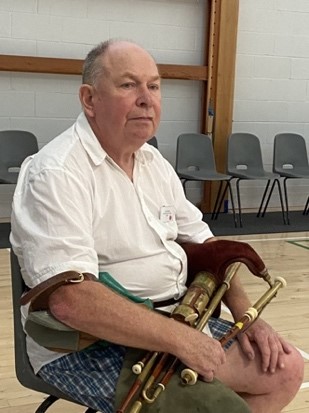
David Gamble with his Uillean pipes at the social evening
For more than a decade, Margaret Fraser has accompanied North American Friends to Ireland Yearly Meeting. She has now moved to Northern Ireland.
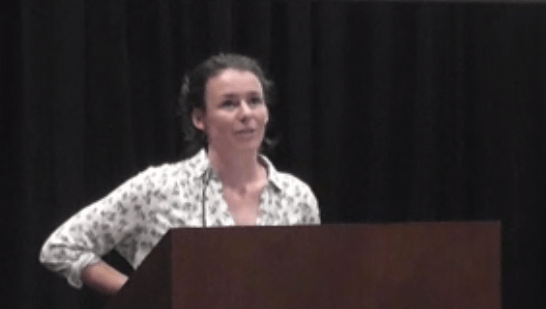
‘Embodying the Quaker Testimonies in Service of a Living Planet: The Challenge of Asking Beautiful Questions’ was the title of this year’s public lecture, which took place on 12th August during Ireland Yearly Meeting 2022 at Stranmillis College, Belfast .
Lynn challenged us to each find our own way to love the Earth, reminding us that faith and action nourish each other.
She also asked us to consider whether surrendering ourselves to the way of Love might, perhaps, be our spiritual gift to the environmental movement.







 quakers-in-ireland.ie
You must be logged in to post a comment.