Here you’ll find Episode 3 of the Friendly Podcast.
Daniel Flynn starts at 00:35
Will Haire starts at 39:08
Maggie Knight starts at 01:03:25
Here you’ll find Episode 3 of the Friendly Podcast.
Daniel Flynn starts at 00:35
Will Haire starts at 39:08
Maggie Knight starts at 01:03:25
Here you’ll find Episode 2 of the Friendly Podcast.
Felicity McCartney starts at 00:35
Anne-Marie Woods starts at 29:04
Holly Spencer starts at 50:00
Here you’ll find Episode 1 of the Friendly Podcast.
Tim Gee starts at 00:38
Bridget Guest starts at 27:57
Christopher Moriarty starts at 1:05:35
Here is the Epistle sent out from Ireland Yearly Meeting 2019.
Here is the Epistle sent out from IYM 2021, which was held fully online.
‘Quaker Quest’ is a series of meetings aimed at people who would like to learn more about Quakers. These meetings include sharing of Friends’ experiences, discussions and space for inquirers to ask questions.
A series of four new free ‘Quaker Quest’ meetings is being run jointly by South Belfast Meeting and Frederick Street Meeting in late February and early March:
Tuesday 20th February 7pm – Quakers & Worship
Tuesday 27th February 7pm – Quakers & Belief
Tuesday 5th March 7pm – Quakers & World Connections Tuesday 12th March 7pm – Quakers & Living the Testimonies
More information can be found on this poster, or by emailing info@southbelfastquakers.org. Please feel free to distribute to anyone in the Belfast area whom you think may be interested!
Stuart Masters of the Woodbrooke Quaker Study Center gave a presentation on this theme to Ireland Yearly Meeting 2023. This post provides a script of Stuart’s presentation.
This is the script for a presentation made by James Nelson (South Belfast Meeting) on 13 April 2023 to Ireland Yearly Meeting 2023, whose theme was “Building Community Together”.
Our theme this year is Building Community and in my short presentation I want to talk about Fostering community through inter-church and inter-faith encounter from a personal perspective. To begin I want to explore some of the reasons for our Quaker involvement in ecumenical and interfaith work and later I will suggest 3 ways we can help to foster community in those kinds of settings.
The anthropologist, Vered Amit, says that the concept of community is ‘good to think with’ and in preparing this talk I have found that to be the case for when I began to consider what I would say about my topic, I first had to wrestle with obvious questions about community.
What or where is this community? And what kinds of relations between different religious groups can contribute to strengthening that community?
We use the word ‘community’ freely and liberally in many different contexts, ‘local community’, ‘global community’, ‘disadvantaged community’, ‘religious community’ and we employ different metaphors to illustrate the nature of community:
I wonder which image you prefer most, especially when you think about being in community with other churches, people with other worldviews or other faiths?
What is the type of association that we should aspire to in that context? In our Quaker Life and Practice Book (9.15) we are told: ‘Friends have always been open to benefit and learn from the experience of Christians in whatever church they may be in membership. This openness contrasts with the basic lack of interest in the process of church unification.’
So, it would seem in the ecumenical world we’re less melting pot and more salad bowl.
There is more than a sense in the Life and Practice statement that while Quakers can tolerate being in the same bowl they need their boundaries. Quaker kale may bump up against Orthodox olives, or Catholic cucumbers but that’s close enough.
And, interestingly I hear this verbalised by some Irish Quakers who struggle, for example, to attend ecumenical events in churches where women are not awarded full rights of leadership or gay people full rights of membership. They are concerned that participation means endorsement of theologies that are in conflict with quaker testimonies.
So, why is it that we remain faithful to ecumenism, dialogue and interfaith organisations and events?
Well, it is my view that we engage with others in ecumenical and interfaith work because we are different, not just because we have some shared interests. If we all agreed, there would be no need for interfaith forums or church councils. Most people who participate in interfaith and interchurch work come with mixed feelings. This is common when as humans we cross boundaries. We are caught between the in-group safety of our own community and the risk of indifference, rejection or even hostility with the out-group. We are not the only ones who experience both attraction and aversion to these encounters. So, building community through interchurch and interfaith work is not always straightforward and requires effort.
At this point, I will speak personally. First, I should explain that since 2020 I have been the Quaker representative on the Irish Council of Churches and the Irish Inter-Church Meeting. As a Quaker community we were a founding member of the ICC 100 years ago, when 7 Protestant denominations came together to cultivate friendly relations between the churches and engage in joint work. Since then the Council has doubled in size and now includes Orthodox and Independent churches as well. Similarly, Quakers have supported the Irish Inter-Church Meeting since its inception, the IICM is the ecumenical body where the ICC and the Catholic church come together. As well as this, I’m a member of the Northern Ireland inter-faith forum. And I’m not alone, there are many here with past and present involvement in these kinds of activities and who attend ecumenical Peace Days or interfaith activities.
So why do we involve ourselves in these activities? Perhaps in response to the Quaker advice to understand other people’s experiences of the light? Yes, but my view is that we also participate because we know that differences can foster division which in turn leaves space for misunderstanding and mistrust to grow, and when perpetuated over weeks, years or generations can give rise to stereotypes, prejudice and discrimination.
I know this from my own experience. I grew up in an environment where sectarianism was strongly present and I initially accepted what I heard when people of other denominations or religion were demonised in my church, at school etc.
In my early twenties, opportunities to be involved in educational initiatives aimed at building mutual understanding between our divided community changed me, and I have never forgotten the importance of those events and the power of honest yet supportive relational encounters. And it is for this reason that in my professional life and in my work through the Religious Society of Friends that I remain firmly committed to experiences of encounter and bridge building. For me, fostering community is building relationships with others who may be different in order to find issues of shared purpose that provide sufficient grounds for common action. And I believe interchurch and interfaith activities can provide such opportunities. Taking the Irish Council of Churches, for example, the recent list of topics discussed at the last meeting I attended included racism, social justice, the economics of belonging and peace building. Issues about which I believe are core to Quaker concerns. So, these two elements of building relations and collective work around core values provide a strong foundation for my continued involvement.
And I think this is similar to other Friends whose interests in building community are fundamentally relational. We eschew centralisation or building super-structures or shared creeds or even common prayers. In the words of another Quaker, John MacMurray, community is about ‘persons in relation’. Community does not reside in a specific place, a building or an organisation; it is not outside of us but a way of being in relation with others. BYM Advices and Queries speak of engaging with other communities of faith with the purpose of, ‘creating together the bonds of friendship.’ (6). MacMurray’s goes even further, saying:
‘Our human being is our relations to other human beings and our value lies in the quality of these relations. Our relation to God is itself real only as it shows itself in our relation to our neighbours’
So, we continue our participation, not because we want to agree or endorse all the beliefs of others but because through positive relations we can further the work of peace, reconciliation and care for others and the environment.
Returning to where I started – what does all of this mean for fostering community in interfaith and interchurch activity? As I have reflected on this and my own experiences, I have discerned three ways of being that I want to share as my ways of fostering community that may have value for you as we reflect on our Yearly Meeting theme, building community: Be there; Be generous; Be critical.
Amid all our diversity, we have relearned in our assembly that there is a pilgrimage of justice, reconciliation, and unity to be undertaken together.
(a) First, in relation to the Irish Council of Churches, is the status of majority and minority churches. In particular, I am thinking of those churches sometimes referred to as migrant churches who may sit at the same table yet not have an equal voice. Those of us with a white western identity must recognize our privilege and how it affords an unearned power. In a constructively critical way, we need to ask how we help to elevate the voices of those from Black or Asian communities, for example, in ecumenical work.
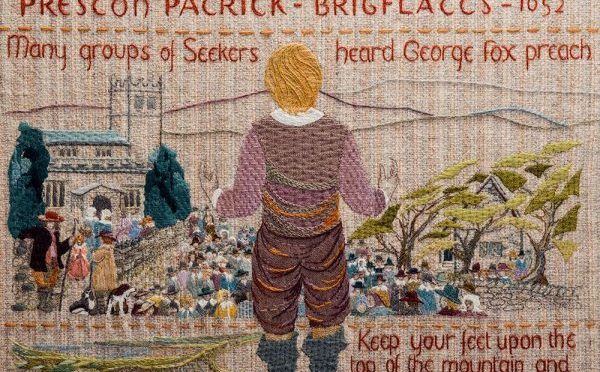
(b) Second, if we think about our salad bowl, we need to think critically about who is inside and who is outside our inter-church and inter-faith bowl. Many churches and faith groups do not currently participate, often for some of the reasons I have mentioned already in relation to fearing that working with others means fully endorsing their theology. Perhaps we can show by example how it is possible to hold two aspirations in tension – fostering community with those who are different and maintaining integrity to our own values. And one way to do this is to think critically about the image of the bowl itself, a hard surface designed to offer a hard boundary. Maybe we can suggest another metaphor to help. Tapestry is an art form sometimes associated with the Quaker tradition, and it provides an interesting alternative metaphor. The distinct images, shapes and designs on the surface are created from many interweaving threads. The tapestry has both unique and common elements, and is open to many creative possibilities. As Farhan Samanani has noted in ‘How to live with each other’:
There is no universal template for community, no one way to be together… [so let’s] not content ourselves with singular visions of togetherness, but let a thousand flowers bloom.
To conclude, I want to thank you for this opportunity and I look forward to the rest of our time together and I hope by the end we will have affirmed the truth of Vered Amit’s claim that the concept of community has been ‘good to think with’.
“We seek to bring together a diverse group of young people to learn more about the United Nations and Quaker work at the multilateral level, build community, and build on existing skills and knowledge. There is some limited bursary support for applicants with most need. “
Applications close on 15 February 2024. For more information on the application process – please visit our website here.
The Fall 2023 Issue of Among Friends – the quarterly journal of the FWCC Europe and Middle East Section – is now available online at the following link:
https://fwccemes.org/news/among-friends-issue-158-autumn-2023
You can find a range of interesting articles, events, book reviews etc in this issue.
You must be logged in to post a comment.