‘Enough is Plenty – Reclaiming the Common Good’ was the theme of an event that took place in the Agápē Centre (South Belfast Methodists) on 24 September 2016. The event was jointly hosted by the Methodist congregation and South Belfast Quaker Meeting.
 Many thanks to Tony Weekes of South Belfast Quaker Meeting for sending us the following report:
‘Enough is Plenty’ is the title of an event which took place at the Agápē Centre (South Belfast Methodists) on the afternoon of Saturday 24 September. It explored what makes for a society where ‘enough is plenty’ – addressing contemporary moral, economic and theological issues in our affluent and waste-prone society.
The theme and content was inspired by the Joy in Enough movement: a challenge to Christians in Britain, and an invitation to all people of good will, to join in building a just economy within the ecological limits of the Earth. The title – Enough is Plenty – was taken from a book by Anne Ryan, a writer, educator and community activist from Co Kildare, and a former member of the academic staff in Maynooth University.
Anne Ryan’s contribution:
 Anne was the principal speaker at the event. Her contribution began by offering an interpretation of Enough: a platform for talking, thinking and acting about the kind of world we would like to live in; Enough as a shorthand for an ecological, moral, love, care, aesthetic world view, bringing together ecology, economics and ethics.
She reminded us that Enough has a good history; it is rooted in past generations and has been valued and practised by several great wisdom traditions. The concept is founded on a belief that humans have the inherent capacity to be cooperative and participative, to share resources and to devise an inclusive social economy and forms of work that foster these capacities and care for the planet.
It brings in the ideas and values of diversity: what we refer to as ‘work’ is much more than paid employment; the need to develop talents for the benefit of all; using the many possible ways of making decisions.
She continued by reminding us that there is a necessary role for responsive government, but that this is a two-way process. We must seek to challenge the views of the dominant media and politics; we must challenge the obsession that public policy is about a return to ‘business as usual’.
It was a rich and eloquent contribution, and impossible to summarise in a few words. To end this very partial summary I offer the following quote from Anne’s aide-memoire:
“Enough is a key concept for the future because it is living, adaptive and dynamic; the future is uncertain, we don’t know the precise things we are going to require. Evidence is past-based – not always suitable for the future. The form of the ecological economy is not to be determined in advance – we don’t really know what it would look like
Enough is a call to action and a practical set of ideas, not solely an intellectual or abstract concept … It is about engagement rather than transcendence – there is no fixed end point, we make the road by walking – of course, there is a risk in entering this space of enough – we don’t know what it will look like. Enough is not an objective but a way of life – there is no end state.”
Tony Weekes’ contribution (a former academic economist’s repentance!):
The second presentation was given by me; I took as my title We need a Society, not an Economy. My primary intention was to remind the participants that the purpose of ‘the economy’ is to serve the needs of society (subject to respect for environmental limits and ecological services) – not the other way round.
It was inspired (as is much of my thinking and writing) by Schumacher’s book Small is Beautiful. I also took inspiration from several recent speeches by President Michael D Higgins and from the writings of a long-time dissenting economist Manfred Max-Neef. Max-Neef was once a conventional academic economist. Confronted – some time ago – by a poor man in rural South America, he realised that his academic learning had nothing to say to the plight of this man and his family. He now refers to himself as a ‘bare-foot economist’, and is an eloquent (and, in academic circles, neglected) advocate for a different kind of economics.
I focussed particularly on his view that there are nine basic human needs, all of which have an impact on ‘the economy’. At first sight, this impact is not apparent; for example, he identifies ‘affection’ as one of these basic human needs. What, the sceptic will ask, does this have to do with ‘the economy’? Plenty, I suggest – affection requires economic stability. Uncertain and unstable employment creates poverty, indebtedness and stress. Outcomes which create an environment which fosters affection, between people in close personal relationships or other, wider relationships.
Another need is participation – a concept to which Anne referred. That too requires relief from the notion of ‘hard work’ so often used by our politicians as the only ‘marker’ for contribution to the economy.
In a few words: our needs are more than shopping. I left it as a discussion topic for the participants to unpack this further.
James Orr’s contribution
The final presentation was provided by James Orr, director of Friends of the Earth in Northern Ireland.
 James offered the title Social Ecology and the Power of Creative Dissent. He showed us, with excellent images, examples of non-violent (‘playful and creative’, in his own words) protests about many aspects of public policy and corporate behaviour. But he also emphasised the need to make it known in the public arena what we do need from government, business and agriculture: energy and food security; action to address the consequences of climate change. And more.
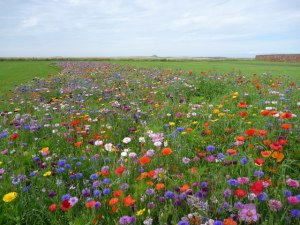
James closed, leaving us with three words on which to reflect: Reconciliation, Ecology (not ‘the environment’!) and Cooperation … and a wonderful image of a wild flower meadow.
The overall form of the event
We began at about 2pm and ended around 5.30, with a short break for tea.
Each contribution was followed by around 20 minutes for participative discussion in small groups. The three main speakers moved around to help, when asked, these conversations.
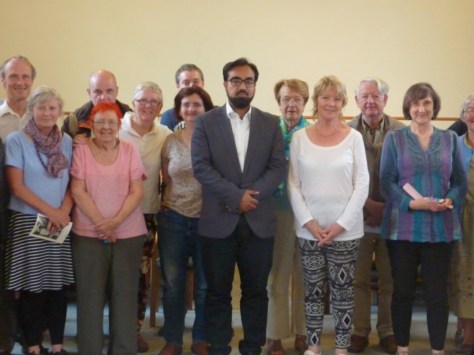
There were around 40 participants. David Campton, the resident Methodist minister, did an excellent job as moderator, with good humour and a sharing of his own insights into the issues we are discussing.
It was sponsored and promoted by South Belfast Methodists and South Belfast Quaker Meeting
Notes:
The Joy in Enough movement: http://www.greenchristian.org.uk/joy-in-enough/
Anne Ryan’s book Enough is Plenty is published by O Books. ISBN: 978-1-84694-239-6.
Speeches on economic issues by President Michael D Higgins: the text of the one I quoted is at http://www.president.ie/en/diary/details/president-gives-the-opening-address-at-the-7th-annual-tasc-conference.
Manfred Max-Neef on Human Needs: a paper on these and their implications can be found at http://www.rainforestinfo.org.au/background/maxneef.htm
Tony Weekes may be contacted at tony.weekes@gn.apc.org.
 There were two major events during 1916 in Ireland. The first was the Easter Rising, a rebellion against British imperial rule. The second was the battle of the Somme in which
  thousands of individuals from this island were killed and injured in a war caused by German and British conflict. This indicates an area of uncertainty and confusion in Irish
  cultural self-perception, different from that of other countries engaged in the 1914-18 war.
 a means of commemorating the individual worth everyone injured or killed in violence, with particular focus on the Somme and the Easter Rising.
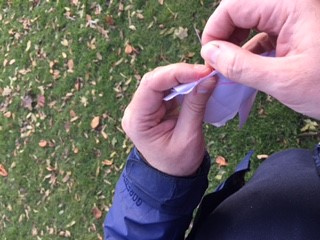
 November we set up a small marquee in one of the main public parklands in Dublin – Merrion Square. We invited anyone walking by to come and make a white poppy, then
  to plant it. 101 poppies were planted during the initiative, which took place the day after the 100-year anniversary of the end of the battle of the Somme (18th November 1916).
 During the day we had readings in French, English and the original and powerful text of All Quiet on the Western Front. There was also a poem in French by Louis Aragon. We ended the day by
  formally laying down each poppy, then standing in a circle around them and reading the 1661 Peace Testimony. We then finished with a couple of minutes’
  silent worship.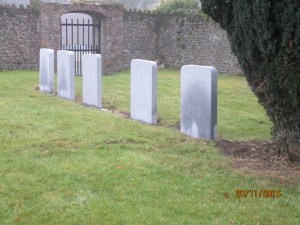



You must be logged in to post a comment.