Category Archives: News and Events

Quakers in Britain call for ‘bridge-building’ following Brexit referendum result

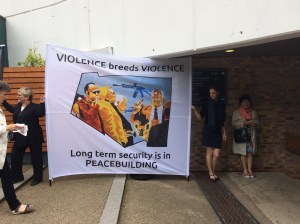
Quakers in Britain are calling for “bridge-building” and the healing of divisions following the result of the Brexit referendum.

In a statement issued on 24th June, Britain Yearly Meeting (BYM) says “there is now a great need for bridge-building, for reaching out to one another in love, trusting that below the political differences lie a shared a humanity and a wish for flourishing communities”.

Acknowledging that the outcome of the referendum, and the campaigning that led up to it, had shown up and sometimes exacerbated divisions within and between communities, BYM says that Quakers in England, Scotland and Wales are committed to working together and with others – including Quakers across Europe – for a peaceful and just world: “In the coming year our Quaker Yearly Meeting will focus on building movements with others locally and globally. We refuse to prejudge who is or is not an ally.”

The statement continues: “Turbulent times can be frightening, but the Spirit is a source of strength for all, guiding us in who we are and what we do. We take heart from the knowledge that with change comes opportunity. We will look for creative ways to find common cause, to listen, to influence and to persuade. As the status quo is shaken we and our neighbours must look to one another for support, wisdom and above all ways of healing divisions.”

The full statement can be read on the BYM website.

EcoQuakers make submission re how Ireland should adapt to climate change

EcoQuakers Ireland have made the following submission to the public consultation on plans for how Ireland should adapt to climate change. This is the first phase of consultation which will eventually result in the first National Climate Change Adaptation Framework by the end of 2017.

Submission to Climate Change Adaptation Framework

EcoQuakers Ireland, a Committee of the Religious Society of Friends (Quakers) in Ireland, has two outstanding concerns to bring to the consultation:

  1. We are called to respond to vulnerabilities in our communities to the increasing effects of climate change. What is needed is nothing less than a transformation in how government responds. We believe the next Framework should contain specific actions to help local communities to understand what is happening, to make decisions, and to take actions to adapt to climate change, rather than to experience climate change as helpless victims of climate events. Communities must be enabled to:
    • engage creatively with how they can respond to climate change;
    • build networks that can inform government decisions; and,
    • design and engage in efforts to prevent potential conflict around climate change impacts.

This is only possible in communities that are resilient. Resilience must be actively nurtured where it is present and developed in communities where it is lacking. We believe community resilience should be an overarching theme in the next Framework.

2. It is nonsense to set adaptation/mitigation policies towards 2050    carbon reduction targets without working to specific and measurable milestones. We need a clear map. It follows that to become a zero carbon nation, mitigation and adaptation mechanisms are required across all sectors, without derogation.

As Quakers, we are called to work for the peaceable Kingdom of God on the whole Earth, in right sharing with all peoples. We recognise a moral duty to cherish our planet, not only for our own sake, but for the millions of people in developing countries already affected by climate change, and for the sake of future generations. As we build sustainability in our Quaker communities, we hope to be part of the change in our local communities to become places of mutual support, collaboration, challenge, laughter and celebration.

Thank you for taking our views into consideration.

~ EcoQuakers Ireland


Ireland Yearly Meeting 2016 overview

Ireland Yearly Meeting 2016 challenged Friends to consider the question “Who is my neighbour?”

The quotation from Quaker Life and Practice which underpinned the theme further probed participants – “How can we, such a small insignificant group of people as the Society of Friends help to stem the tide of evil and hate, and greed and fear that is so wide-spread in the world today?”  (C Winifred Lamb, c.1954, QL&P 4.13).

Such a topical theme was very welcome, and it was addressed throughout the three days in the business sessions, interest groups and public lecture.

Marisa Johnson, FWCC-EMES Secretary

Marisa Johnson, Executive Secretary of the Europe and Middle East section of Friends World Committee for Consultation, presented the Ministry and Oversight session on the first evening with the intriguing title ‘The Gift of Conflict’.

Will Haire
Will Haire, South Belfast Meeting

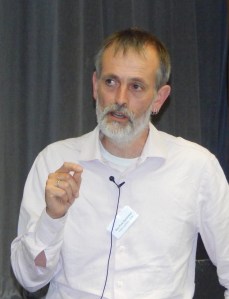
Will Haire of South Belfast Meeting delivered the public lecture titled ‘Who is my neighbour? What is our testimony on inclusion?’

Andrew Lane from the Quaker Council for European Affairs addressed the question ‘Who is my Neighbour in Europe?’ and there were several speakers on the topic of homelessness in Ireland.

IYM agreed to publish a statement on homelessness, and to write letters to politicians and to newspapers both sides of the border, calling for the provision of good quality social housing.

IYM also made a resolution to become “as sustainable as possible”, with each Meeting asked to prepare a sustainability plan before the end of the year.  A commitment was also made to develop an investment strategy by January 2017 to ethically invest all funds within Yearly Meeting in sustainable and peaceful companies, and to divest from destructive industries, including fossil fuels.

For the first time during a Yearly Meeting in Ireland, there were regular updates on IYM’s Facebook and Twitter and Friends who use social media were encouraged to like, comment, share and tweet.

Read the full IYM 2016 Report by Pleasunce Perry of Frederick Street Meeting, Belfast, and Robert Foulkes of Cork Meeting.


Friends participate in Ecumenical Bible Week 2016

Thinking Allowed - Ecumenical Bible WeekRachel Bewley-Bateman of Churchtown Meeting, Dublin (pictured second from right), delivered a talk on the theme ‘Thinking Allowed – What Bible passages inform and challenge my response to climate change?’ during Ecumenical Bible Week.

Rachel, who is former Clerk of the Europe and Middle East Section of the Friends World Committee for Consultation and has an MA in Biblical Studies, was representing Friends in a chaired panel discussion and open forum, which was held on 19th May in St Paul’s, Arran Quay, Dublin.

Other speakers at the event included:

Archbishop Michael Jackson (Church of Ireland)
Gillian Kingston (Methodist Church)
Archbishop Diarmuid Martin (Roman Catholic Church)
Rev Katherine Meyer (Presbyterian Church)
Pastor Nick Park (Evangelical Alliance)

The full text of Rachel’s talk may be read here.

To find out more about Ecumenical Bible Week, see http://www.bibleweek.ie/.


IYM issues statement on homelessness to politicians North and South

Ireland Yearly Meeting has issued a statement on homelessness to politicians North and South of the border calling for urgent action to be taken on the issue of homelessness, including the provision of good quality social housing.

The statement came about as a result of considerable discussion at Yearly Meeting (held in King’s Hospital, Dublin from 31st March to 3rd April 2016), which had been prompted by presentations from several homeless charities.

The full wording of the statement follows:

The Religious Society of Friends in Ireland (Quakers), gathered at its annual meeting, wishes to express its serious concern about the increasing numbers of homeless individuals and families.

In the past Quakers recognised the importance of good quality social housing, and today we believe a home is a fundamental human right.  In this context homelessness is frequently the manifestation of dysfunctional housing provision and weakness of effective policy and regulation.  We call on the authorities in both jurisdictions of Ireland to take urgent action to address the underlying structural causes of homelessness, including –

  • The appropriate provision of social housing
  • Strengthening the rights of tenants in the private rented sector
  • Removing the obstacles to making vacant properties available for occupation.

“A key message for Quakers is the importance of housing as a home, providing a secure place in which to thrive, not merely an individual financial investment.”

(Paula Harvey, Quaker Housing Trust UK)

DSCN1661
Pictured before the session on homelessness at Yearly Meeting from left to right: Dan Sinton, (outgoing) IYM Clerk, Peter Ramsey of Frederick Street Meeting, Nigel Bell of Churchtown Meeting, Fr Peter McVerry SJ of the Peter McVerry Trust and Rosie Castagner, IYM Recording Clerk

The following letter has also been sent to the editors of the national daily papers both sides of the border:

Dear [Editors Name]

The Religious Society of Friends (Quakers) in Ireland wishes to express its serious concern about the increasing number of homeless individuals and families both south and north of the border.

At our recent Yearly Meeting in Dublin, we heard presentations from people engaged in several different homeless charities.

In the past Quakers recognised the importance of good quality social housing and today we believe a home is a fundamental human right.  In this context homelessness is frequently the manifestation of dysfunctional housing provision and weakness of effective policy and regulation.

We therefore call on the authorities in both jurisdictions of Ireland to take urgent action to address the underlying structural causes of homelessness, including the appropriate provision of social housing; strengthening the rights of tenants in the private rented sector; and removing the obstacles to making vacant properties available for occupation.

Yours sincerely,

Daniel H Sinton,

Clerk of Ireland Yearly Meeting of the Religious Society of Friends (Quakers) in Ireland

This letter was published in The Belfast Telegraph.


EcoQuakers & DMM sign Inter-Faith Statement on Climate Change

EcoQuakers and Dublin Monthly Meeting have signed an Inter-Faith Climate Change Statement that has also been signed by many of the world’s religious leaders.

The statement will be handed over to the President of the United Nations General Assembly at a special faith-based ceremony in New York on 18th April 2016.

The Irish Council of Churches and the World Council of Churches have also signed the statement as have religious leaders and individuals of all faiths around the globe.

The purpose of the statement is to follow up on the Paris Agreement.  Right now the agreement is just words on paper. In order to make the world a better, safer place for ourselves and for future generations, it is necessary for world leaders to start taking action – to commit to 1.5°C limit of warming to protect the vulnerable.

Individuals can sign the statement too (until 17th April) here >> http://www.interfaithstatement2016.org/.

Six Key Points within the Interfaith Climate Change Statement:

  1. Urge governments to rapidly sign, ratify and implement the Paris Agreement, and to increase pledges to reduce emissions in line with keeping the global temperature rise to 1.5C above pre-industrial levels;
  2. Insist on rapid emissions reduction and peaking by 2020, in order to keep the 1.5C goal within reach;
  3. Strongly advocate for greater flows of finance, especially for adaptation and loss and damage;
  4. Urge the swift phase out of all fossil fuel subsidies and a transition to 100% renewable energy by 2050;
  5. Encourage faith communities to reduce emissions in their homes, workplaces and centres of worship and to support and stand in solidarity with communities already impacted by climate change; and
  6. Call for fossil fuel divestment and reinvestment in renewables and low carbon solutions, including within our own communities, and/or by engaging companies on climate change.

Irish Quakers commit to sustainability and ethical investments

Quaker Meetings in Ireland are set to become “as sustainable as possible”, following a resolution made by Ireland Yearly Meeting (IYM) on 3rd April 2016.

Each Meeting is asked to develop a sustainability plan before January 2017, taking into consideration factors such as accessibility by public transport, energy efficiency, use of Fairtrade tea and coffee and use of organic and locally sourced food, when possible (EcoQuakers are drawing up a template plan to help Meetings in this process).

IYM is asked to take the same factors into account when planning the next Yearly Meeting.

A commitment was also made to develop an investment strategy by January 2017 to ethically invest all funds* within Yearly Meeting in sustainable and peaceful companies, and to divest from destructive industries, including fossil fuels.

These two commitments were made following the call to action on sustainability that came from the Friends World Committee for Consultation’s Plenary in Peru in January 2016, urging the worldwide Quaker community to re-double its efforts in relation to sustainability.

*this includes all funds invested for growth or income by Yearly Meeting, Quarterly Meetings, Monthly Meetings and Preparative Meetings

Minute 40 of Ireland Yearly Meeting 2016:

Call to action on Sustainability from Friends World Committee for Consultation (FWCC) Plenary in Peru Claire Conboy-Stephenson has read the minute agreed at the FWCC Plenary in Peru urging the worldwide Quaker community to re-double its efforts in relation to sustainability. It calls on Yearly Meetings to initiate at least two concrete actions on sustainability by January 2017.

The Special Interest Group facilitated by Eco-Quakers Ireland has reflected on this and has proposed a number of actions. We agree to the following two actions:

1.To commit to making all the Meetings within Ireland Yearly Meeting as sustainable as possible, considering such factors as accessibility by public transport, energy efficiency, use of Fairtrade tea and coffee and use of organic and locally sourced food when possible. We ask Meetings to develop a sustainability plan, no matter how simple, before January 2017. We ask Ireland Yearly Meeting to take its sustainability plan into consideration when planning for its next Yearly Meeting.

2.To follow in the steps of FWCC by developing an investment strategy, by January 2017, to ethically invest all the funds within the Yearly Meeting in sustainable and peaceful companies, and divest from destructive industries, including fossil fuels.

We also ask all Meetings to consider how truth prospers with regard to sustainability, taking care to relate this to all of our testimonies – peace, simplicity, truth and equality.

Newtown Junior School marks Ireland 2016 by creating a peace garden

DSCF4012
Artist Ciara Harrison and Newtown pupils making poppies for the    Indoor Garden of Peace

Newtown Junior School in Waterford (Ireland’s only Quaker national school) has chosen to mark Ireland 2016 by creating an Indoor Garden of Peace.

Artist Ciara Harrison, a Rathfarnham Quaker and a past pupil of Newtown Secondary School, came up with the idea for the collaborative and educational art project and helped the children bring the peace garden to life.

“As a national school, Newtown Junior School was required to commemorate the anniversary of the 1916 Rising,” said Ciara, “But, as a Quaker school, it was important for them to respect the Quaker ethos of peace, pacificity and non-violence.

“We took on the approach of looking to the future – to the next 100 years – to promote a world of peace. We decided to use the symbol of a white poppy to do this.

Peace Garden_1“The initiative of the white poppy began in Britain in 1933 by a women’s pacifist group as a symbol of peace and non-violence. This symbol is widely used among Quakers in Britain and also in Ireland.

“We were inspired by this group and decided that we would produce a garden of peace where each pupil would produce a poppy (using recycled white fabric) that would then be installed in an area of the school, creating an Indoor Garden of Peace that would invite visitors, staff and pupils to walk among it and, at the end of the exhibition, to take a poppy of peace home with them.”

Fairtrade makes a huge difference, banana farmer tells Rathfarnham Friends

Buying Fairtrade products makes a huge difference to the lives of farmers and producers, a banana farmer from the Dominican Republic told  Rathfarnham Friends when she visited their Meeting on 6th March.

DSCN1572Maria Genao, who undertook a speaking tour of Ireland to mark Fairtrade Fortnight, said that the impact that Fairtrade had on the lives of small producers were many. “It ensures our work as producers by protecting the market throughout the year, by helping us in many ways to keep growing and by being there through tough times when we are in need,” she said.

Maria, who works on her mother’s 3.5 hectare farm, said that the premium Fairtrade farmers received gave them stability during fluctuations in the market, like when there was no rain for 18 months, which drastically impacted the amount of bananas produced. It also enabled communities to put money into health and education and allowed farmers to live with dignity.

Maria has also set up a handcraft business, which sees local women and young people making baskets and table cloths from banana fibres. She hopes to find an export market for these items in the near future and to explore the possibilities of making other products from banana fibres.

DSCN1579Rathfarnham Friends were pleased to be joined by Friends from other Meetings – adults and children – to hear their special speaker.

The twelve children present were interested to hear that Maria and her family eat bananas at every meal and that, as well as eating ripe yellow bananas and banana pancakes, they cook green bananas, which they mash like mashed potatoes.

Rathfarnham Meeting made a commitment some years ago to only buying Fairtrade tea and coffee. To find out more about Fairtrade, see www.fairtrade.ie.